How can foil become a little boat?
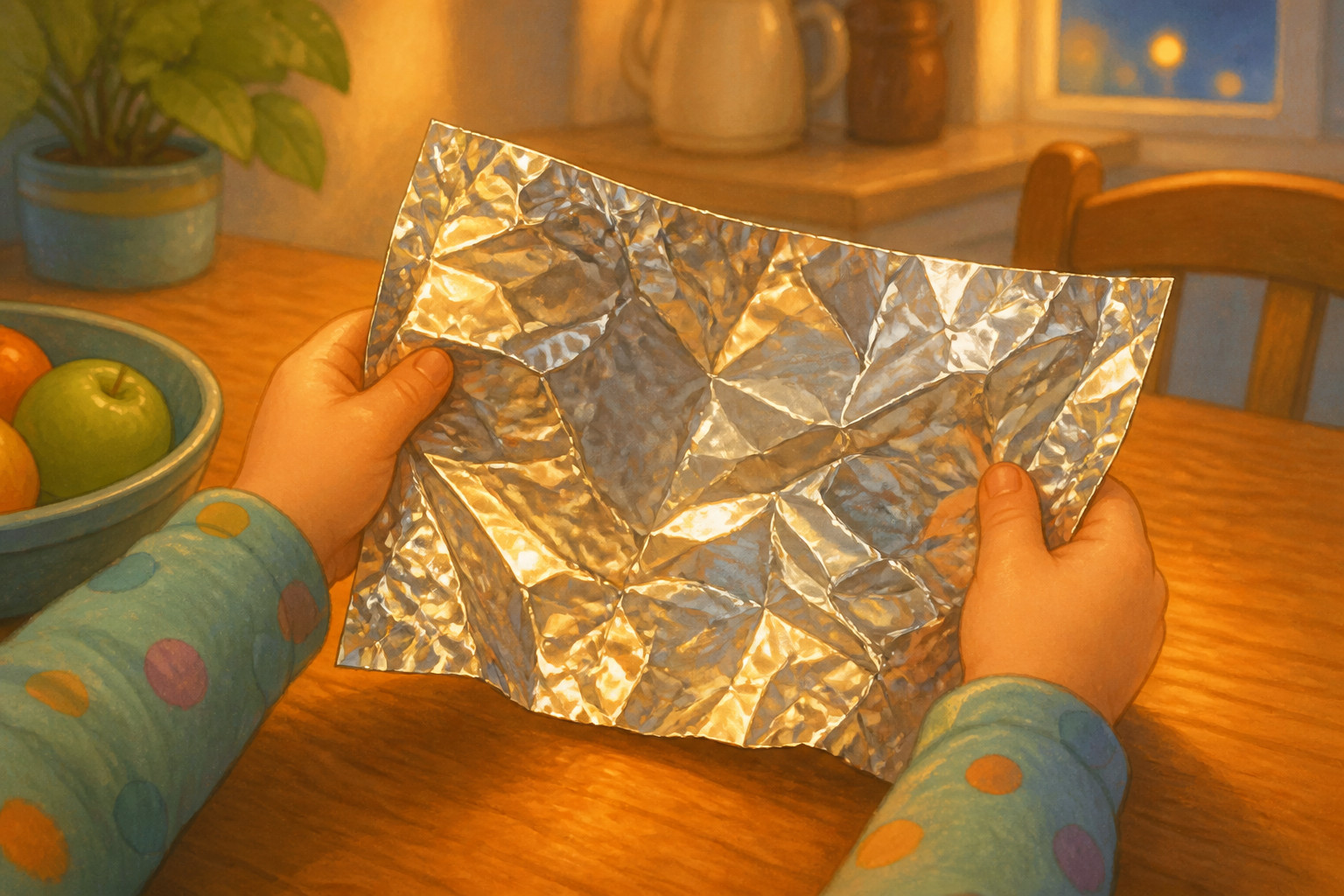
Have you ever held a sheet of shiny foil? It crinkles when you squeeze it, and it feels cool and thin. In the kitchen, foil wraps sandwiches and covers bowls.
Now picture that thin, flat sheet in a bath full of water. Could it carry a tiny toy across? How can foil become a little boat?
First, a grown-up tears a square of foil off the roll, because the box has a sharp edge. The foil is so thin that it bends under your fingers. That lets you shape it any way you like.
Now you fold one edge up, all the way along. Pressing the fold flat leaves a crease, which means a sharp line where the foil bends. Foil keeps its crease, and the edge stays standing up.
Next you fold up the other three edges, each with a firm crease. Four walls stand around a flat bottom. Now the foil is a hull, which means the body of a boat that sits in the water.
At each corner, you pinch the foil together. Pinching joins the walls, so they go all the way round with no gaps. When you set your hull on the water, what do you think those walls will do?
The walls stay up above the water and keep it out. Inside the hull there is only air, so the little boat stays light.
Underneath, the wide flat bottom presses down on the water. The water pushes back up on the hull. That push up is stronger than the pull down on the light foil, and the boat floats!
Crease. Hull. You fold foil into a hull whose walls keep water out, so it floats.
Next time you hold a sheet of foil, you can fold your very own little boat and watch it float.