How does a cat use its whiskers in the dark?
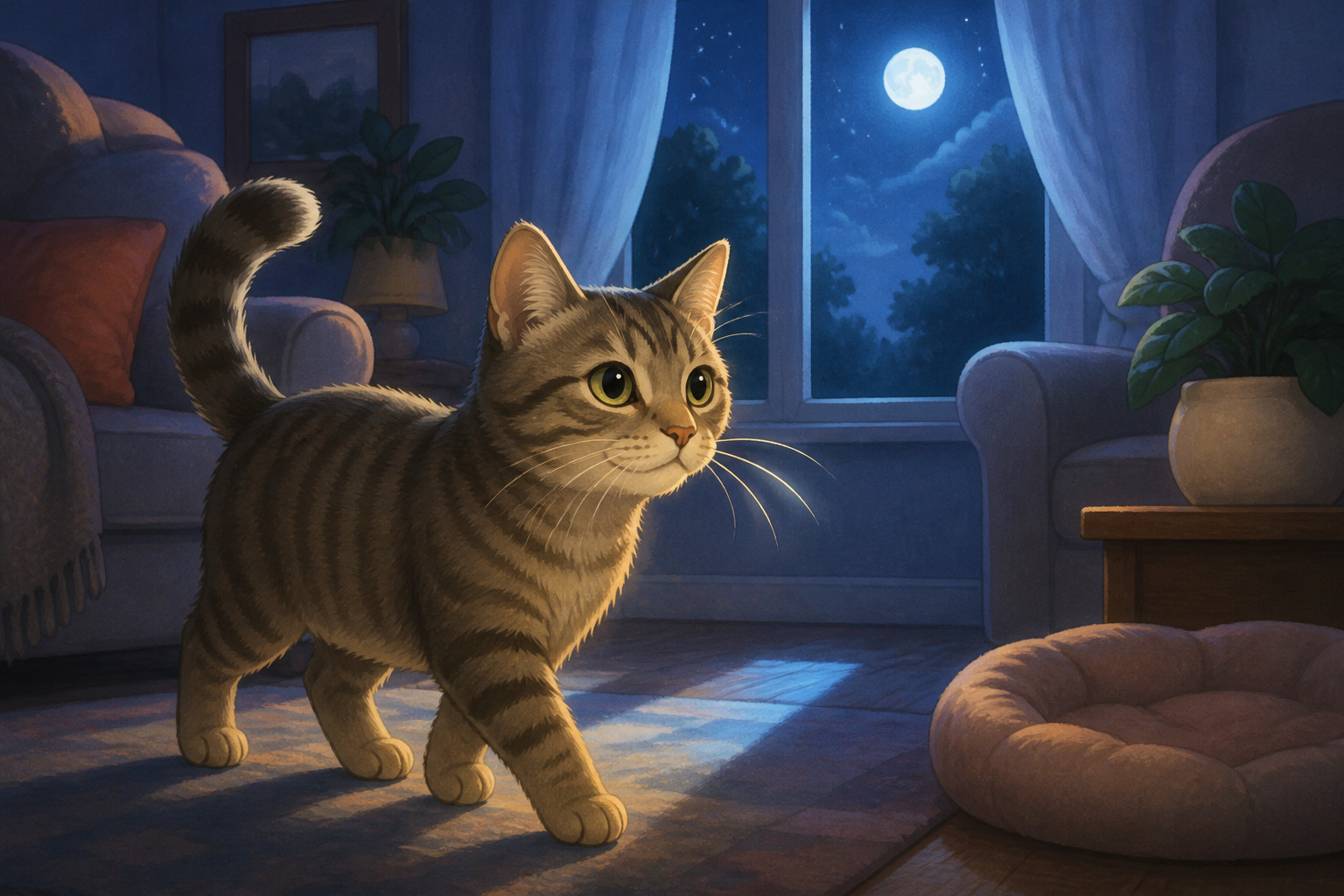
Picture a cat padding through a dark house at night. When you gently stroke its cheek, you can feel long, stiff hairs poking out beside its nose. Those are the cat's whiskers.
Even with all the lights off, the cat slips past chair legs without a single bump. So how does a cat use its whiskers in the dark?
A whisker is much thicker and stiffer than the soft fur around it. Its root reaches deep inside the cat's cheek, far deeper than a fur hair. That deep root lets each whisker work like a feeler.
Each whisker root has nerves curled all around it, and nerves are tiny threads that carry touch messages to the brain. When something brushes a whisker tip, the whole whisker wiggles at its root. The nerves feel that wiggle and send a message to the cat's brain right away.
A whisker can feel things before it even touches them. As the cat walks, it pushes the air in front of it, and that air swirls in a new way around a chair or a wall. The whiskers feel that soft swirl of air, so the cat knows something is close before its nose bumps it.
Each whisker sends its own message, so the cat knows which side a thing is on. When the whiskers on its left side bend, the cat steps to the right. That is how it glides around the furniture in a dark room.
The longest whiskers on a cat's face spread out about as wide as its body. Now imagine the cat reaches a narrow gap under a fence at night. What do you think its whiskers can tell it?
The cat pokes its face into the gap first. If the whiskers slide through without bending back, its body fits too, and in it goes. If the whiskers squash back hard, the cat knows the gap is too tight and turns around.
A cat cannot see clearly what sits right under its nose, even in daylight. So when it pounces on a toy mouse in the dark, the cat swings its whiskers forward like a net. The nerves tell it exactly where the toy is, and its paws know where to grab.
In the dark, a cat's whiskers wiggle at their roots whenever they brush something or feel the air swirl. The nerves around those roots tell the cat's brain where things are, so it can step around them and squeeze only through gaps that fit.
So the cat pads on through the quiet, dark house, its whiskers spread out wide on both sides of its face. Past the chair legs and around the table it goes, without a single bump.