How do we know where a faraway spacecraft is?
Have you ever called out to a friend across the playground and waited to hear them call back? Their voice takes a little moment to reach you, and their answer takes a moment to come back. Now picture a spacecraft so far away that you cannot spot it in the night sky at all.
Some spacecraft fly past the planets and out beyond them, farther than any road or ocean. Nobody can see them from home, not even with a strong telescope. So how do we know where a faraway spacecraft is?
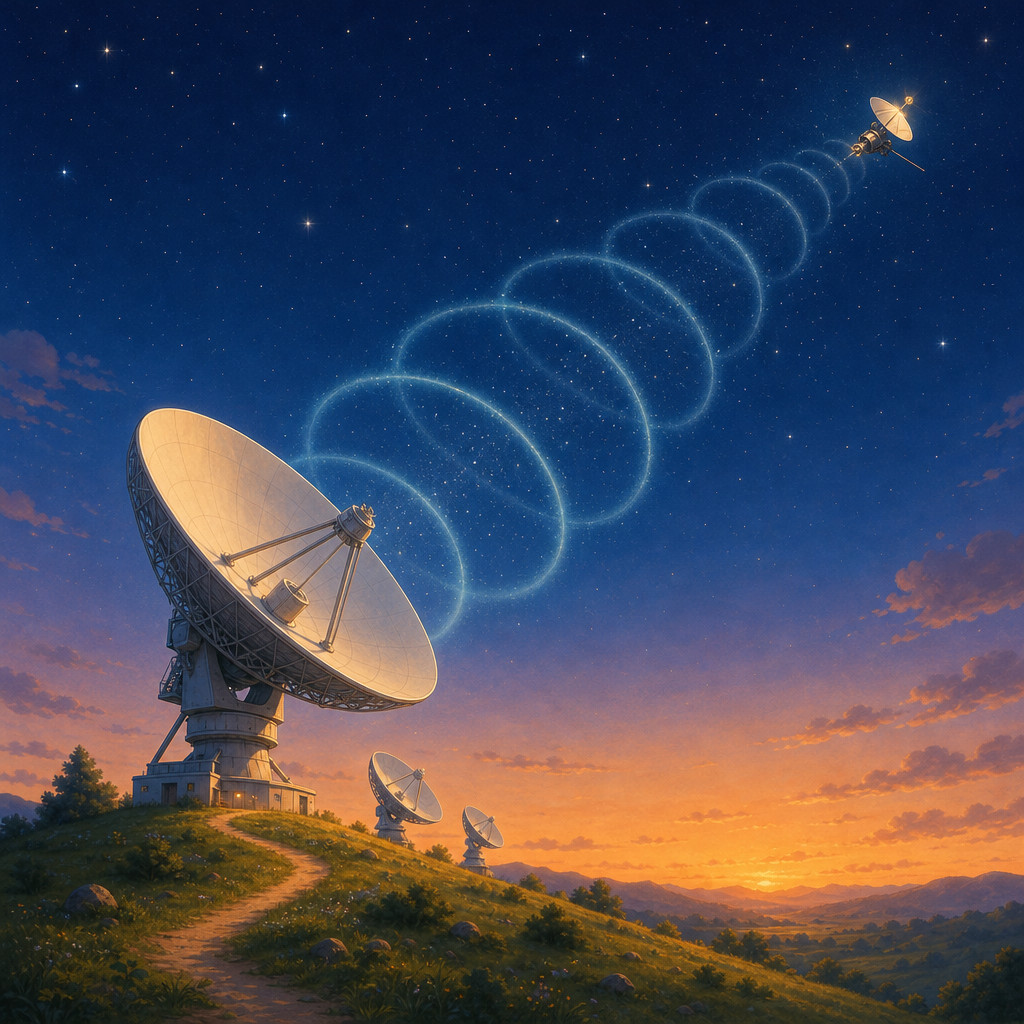
The answer starts with a space team on Earth and a giant antenna, which means a huge metal dish that sends and catches messages. This dish is as wide as a whole playground and faces up at the sky. The team needs one this big because a small dish could never reach a spacecraft so far away.
The team sends a message through the antenna as radio waves, which means invisible ripples that carry messages. Radio waves are what bring music to a car radio. Out in space they zoom along as fast as anything can ever go.
Far away, the spacecraft has its own antenna, listening for the team. When the radio waves reach it, the spacecraft sends a reply straight back to Earth. That reply is how the team hears from it.
Back on Earth, the team starts a careful clock the moment their message leaves. They stop the clock the moment the reply arrives. What do you think that waiting time can tell them?
The waiting time tells them how far away the spacecraft is! Radio waves always travel at the same speed, so a longer wait means a longer trip. The team turns the wait into a distance, the same way you know a long walk takes more time than a short one.
A reply from a spacecraft near the Moon comes back in less than three seconds. A reply from the farthest spacecraft takes almost two whole days, because its radio waves have such a long way to go.
Knowing how far is not enough, because the team also needs to know which way to look. The team aims the antenna until the reply comes in strong and clear. Where the antenna points then shows which way across the sky the spacecraft is.
Now the team knows how far away the spacecraft is and which way. Together, those two answers give its place in space. It is like knowing your friend is ten big steps away, over by the swings.
Two words to keep are antenna and radio waves. The space team sends radio waves from a giant antenna, times how long the reply takes to learn how far away the spacecraft is, and checks where the antenna points to learn which way it is.
Next time you look up at the night sky, you can wave to the faraway spacecraft still sending their replies home.