Why do most space rocks burn up in the sky?
Close your eyes and picture a dark night sky. Feel the cool night air on your cheeks. See the stars twinkling far, far away.
Far beyond our sky, out in space, there are rocks too. Here is something to wonder about. Why do most space rocks burn up in the sky?
Most space rocks are tiny. Many are as small as a grain of sand on the beach. They drift quietly through dark space.
Out in space, there is no air at all. Our Earth is different. Earth wears a soft blanket of air all around it, and you breathe this air every day.
Some space rocks drift close to our Earth. Earth pulls them in, and down they zoom, much, much faster than a jet plane. Whoosh! They race right into Earth's blanket of air.
The air in front of the rock cannot get out of the way fast enough. The rock pushes that air and squeezes it tight, like you squash a pillow flat. What do you think happens to air that gets squeezed so hard?
It gets hot! The squeezed air in front of the rock gets hotter than a campfire. It glows bright, and it heats the tiny rock until the rock glows too.
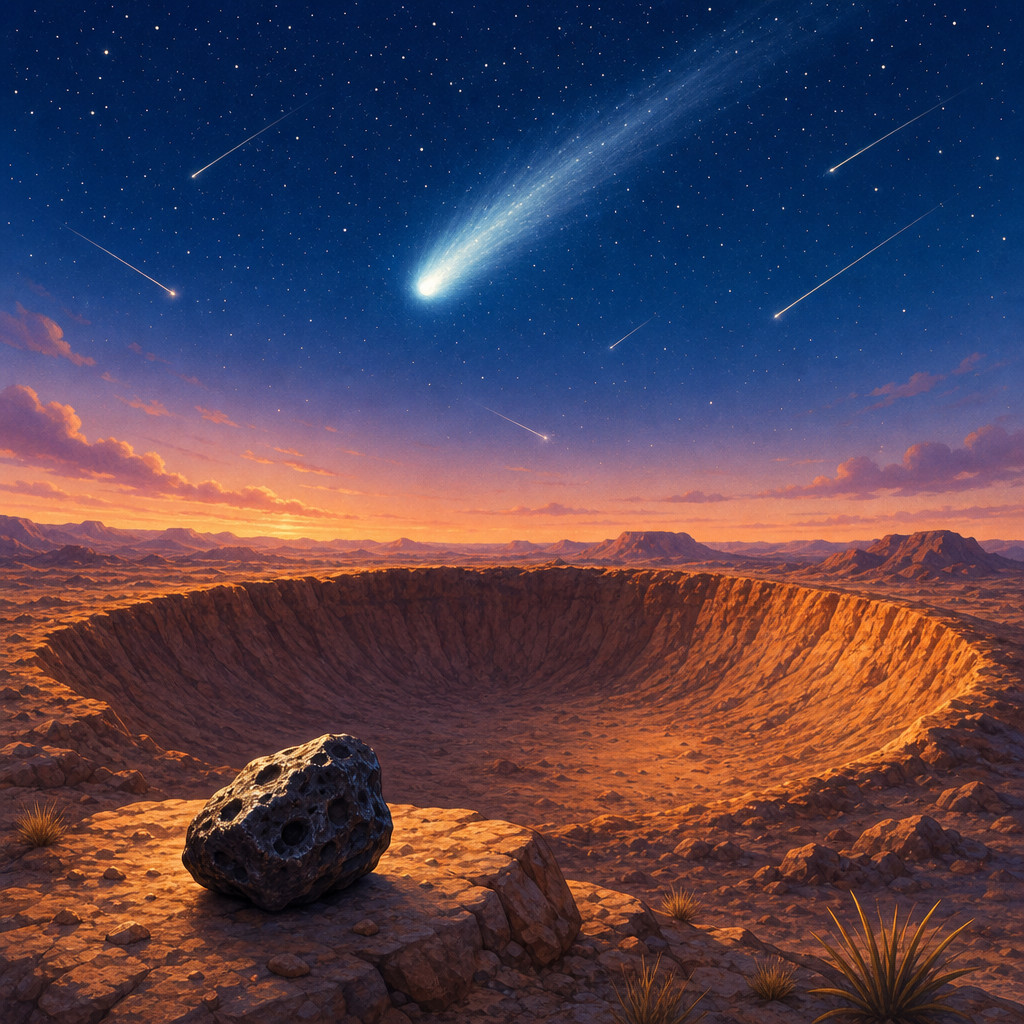
The heat burns the tiny rock away, bit by bit. Down on the ground, we see a quick streak of light. That streak is a shooting star, which means a tiny space rock burning as it falls. It is not a real star at all.
Most space rocks are so small that they burn away high up in the sky. Each shooting star is gone in a blink, long before it reaches the ground. Nothing is left but a tiny puff of dust.
Space rocks zoom into our air so fast that the squeezed air heats them. The tiny ones burn away as shooting stars.
High above the dark hills, a little space rock glows and streaks across the sky. In a blink, the shooting star is gone. Only a soft puff of dust floats in the quiet night air.