How do we know a fuzzy blob in the sky is a galaxy?
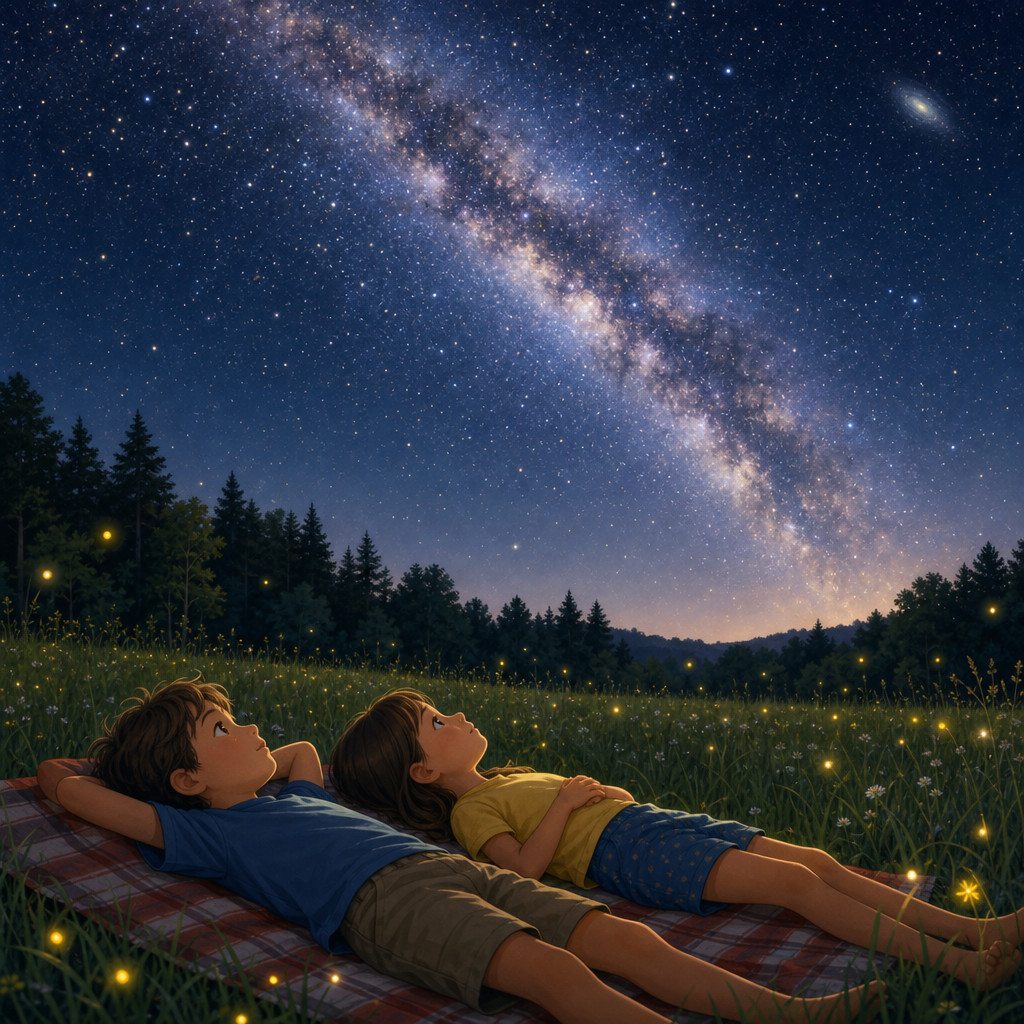
On a dark night, far from town lights, look up and let your eyes rest. Here and there, a faint, fuzzy patch of light glows, softer than any star. Even through a small telescope, it still looks like a blurry smudge.
That smudge could be one of three things. It could be a glowing cloud of dust and gas, or a tight bunch of stars. Or it could be a galaxy, a giant family of stars far away. So how do we know when a fuzzy blob is a galaxy?
The people who find out are astronomers, which means scientists who study the sky. Let's follow the astronomers as they check one famous blob, called Andromeda. You can spot it on a dark autumn night, a pale smudge among the stars.
First, astronomers point a giant telescope at Andromeda. A giant telescope gathers far more light than our eyes can, so it shows tiny details. Up close, the smudge breaks into thousands and thousands of tiny dots, and each dot is a star.
Now the astronomers cross off the glowing cloud, because a cloud of gas does not break into stars. Two choices are still left. A bunch of stars close to us would look like this, and so would a galaxy far away. What do you think the astronomers need to find out next?
They need to find out how far away the blob is. Every star you can see on your own at night belongs to our home galaxy, the Milky Way, which means the huge family of stars our Sun lives in. A bunch of stars inside the Milky Way is close, but a separate galaxy sits far outside it.
To measure the distance, astronomers look for special stars inside the blob that blink. These stars slowly grow brighter and dimmer, again and again. The slower a star blinks, the brighter it truly shines, so its blink tells astronomers how bright it really is.
Next, astronomers compare that true brightness with how faint the star looks from Earth. A light far away looks dimmer, like a flashlight at the end of a long street. Andromeda's blinking stars look so faint that they must be very far away.
That distance gives the answer. Andromeda lies far beyond the edge of the Milky Way, so far that its light travels for more than two million years to reach us. It cannot be a bunch of stars near us. It is a whole galaxy of its own.
Astronomers. Milky Way. Astronomers know a fuzzy blob is a galaxy when a giant telescope shows it is made of stars, and its blinking stars show it lies far outside the Milky Way.
Next time you spot a fuzzy smudge in a dark sky, you can wonder if it is a whole galaxy of stars, shining to you from far, far away.
 Fenn