How do trees and grass stop a city flooding?
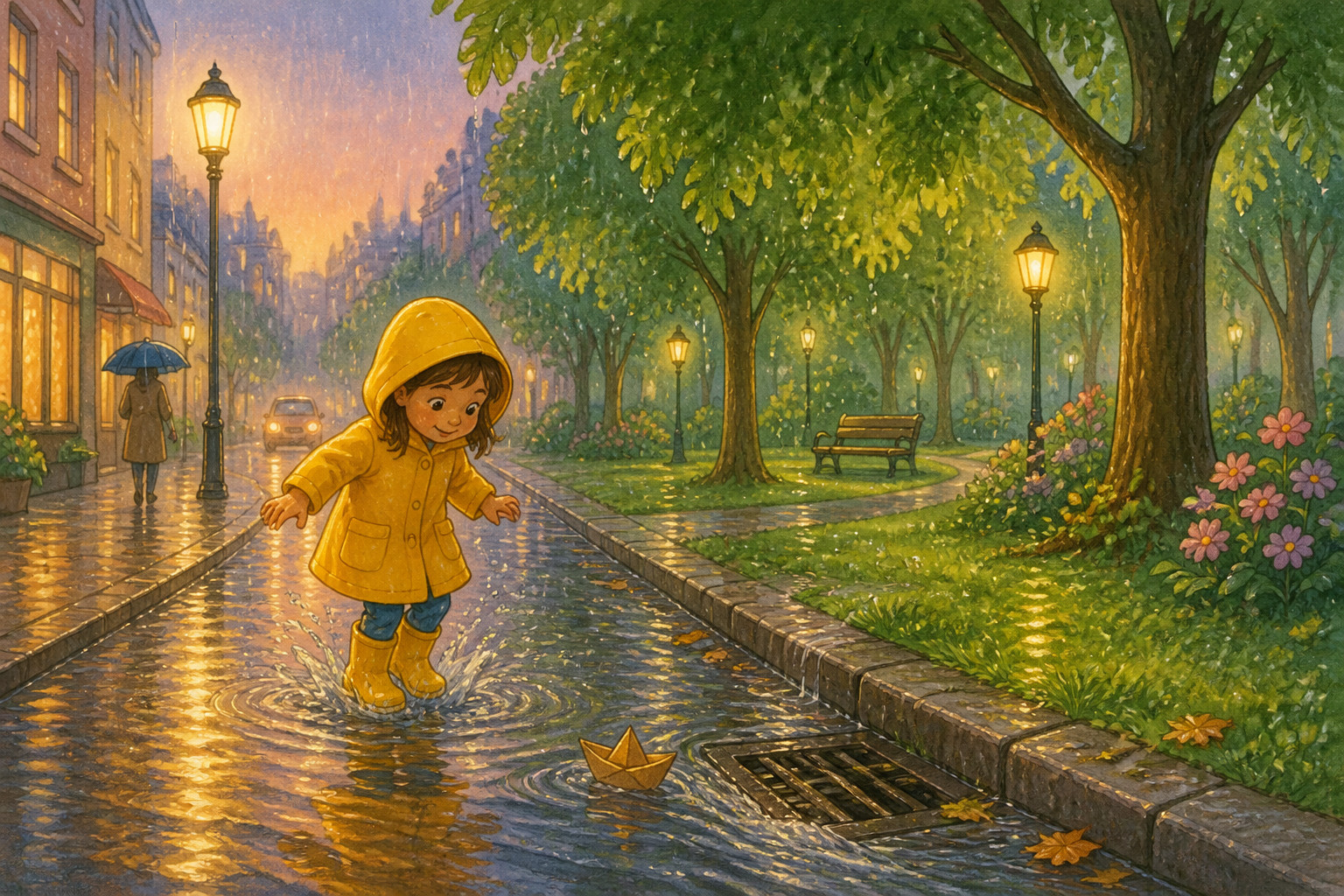
Think of a rainy day in the city. Water splashes off the pavement, gushes along the edge of the road and gurgles down into the drains. Now picture a park in that same rain, with fresh-smelling grass and tall, dripping trees.
When rain pours down hard, a street can fill with water like a bathtub. So how do trees and grass stop a city flooding? Let's follow the raindrops and find out.
Hard things like roads, roofs and pavements cover most of a city. Rain cannot sink into them, so it slides away across the top. We call this water runoff, which means rainwater that runs over the ground instead of sinking into it.
All that runoff rushes toward the drains at the same time. The pipes under the street can carry only so much water at once. When too much pours in, the drains fill up and the water spills back into the street, and that is a flood.
Now let's look at a tree in the rain. Its leaves and branches catch the falling drops and hold them for a while. Then the water drips down a little at a time, so it reaches the ground gently instead of all at once.
Under the tree and all around it, grass grows in soft soil, not on hard road. Grass roots and tree roots wriggle through the soil and keep it full of tiny gaps, like a sponge. So what do you think the rain does when it lands on this soft, spongy ground?
It soaks in! The water trickles down into all those little gaps and stays in the ground. Rain that soaks in never becomes runoff at all.
On a green street, much less runoff reaches the drains, and it arrives slowly. The pipes have time to carry it all away, so the water stays out of the street.
Our special word today is runoff. Trees and grass stop a city flooding because their leaves slow the falling rain and the soft soil around their roots soaks it in, so less runoff rushes into the drains at once.
Next time you hear rain tapping on the window, you can picture the trees and grass outside, catching the drops and helping them sink softly into the ground.