Why don't satellites fall down to Earth?
Think about tossing a ball high into the air. You feel it leave your fingers, and up it flies. Then, every single time, it drops back down to the ground.
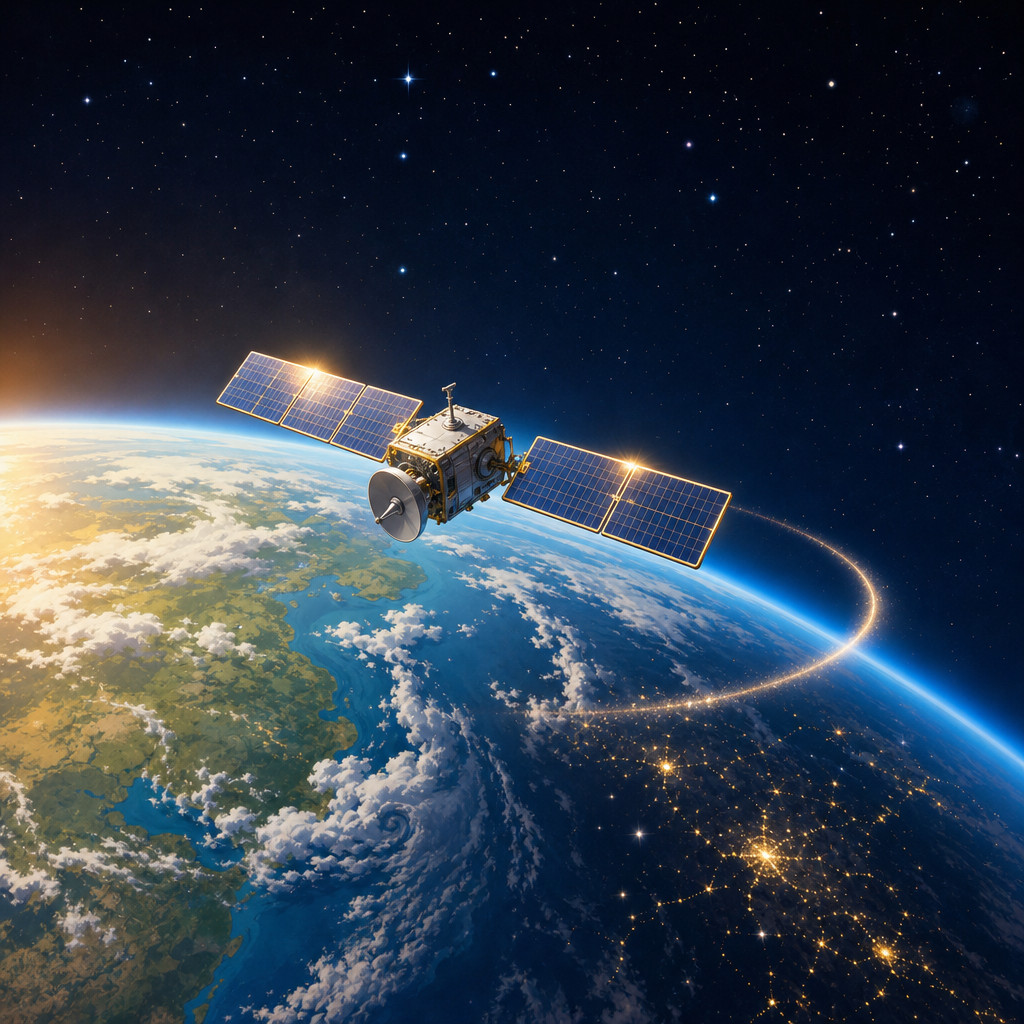
Far above the clouds, satellites circle our planet day and night, for years and years. They carry no wings, and no one holds them up. So why don't satellites fall down to Earth?
First comes a pull. Earth tugs everything toward its middle, and this tug is called gravity, which means the pull that brings things down to the ground. Gravity is the reason your ball came back to you.
Gravity reaches all the way up into space, too. It tugs on every satellite, all the time. So a satellite really is falling toward Earth, right now and always.
Here is the second part. Satellites close to Earth zoom sideways around it at about eight kilometres every second. That is far faster than a racing car or a jet plane, and nothing in empty space slows them down.
Picture throwing a ball straight out in front of you. A gentle throw lands close to your feet, and a harder throw flies much farther before it lands. So what do you think happens to something that goes sideways as fast as a satellite?
Earth is round, like a giant ball, so the ground below curves away. The satellite falls and falls, but the curving ground drops away just as fast. It never catches up with the ground.
So the satellite falls all the way around the Earth and comes back to where it began. Then it just keeps going, loop after loop, high above us.
Gravity. Earth's gravity pulls every satellite down, but the satellite zooms sideways so fast that it keeps falling around our round Earth instead of onto it.
As you snuggle down tonight, you can think of all those satellites high above you, falling and falling around the Earth while you drift off to sleep.