Who nibbled this pine cone?
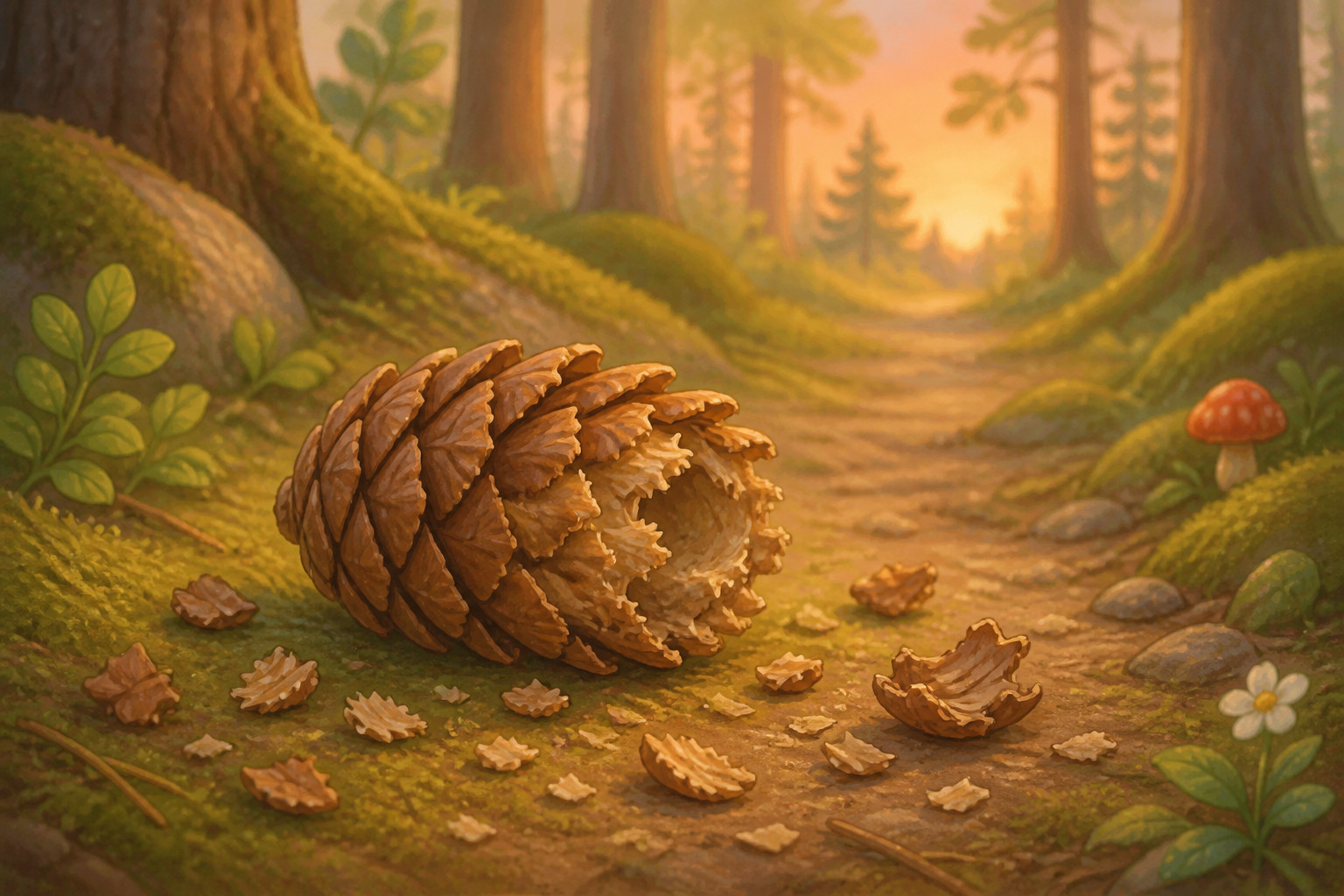
Have you ever found a pine cone lying on a forest path? Picture holding one in your hand. It feels rough and bumpy, and it looks chewed.
Someone hungry has been here before you. Let's find out together. Who nibbled this pine cone?
A pine cone is covered in scales, which means small woody flaps that overlap like roof tiles. When the cone is closed, the scales press together tight. That keeps what is inside safe.
The pine tree keeps its seeds tucked under the scales. Seeds make a tasty, filling snack. That is why hungry forest animals come looking for pine cones.
Three animals in the woods love these seeds. A squirrel and a mouse bite with sharp front teeth. A woodpecker pecks with its strong, pointy beak.
Each animal eats in its own way, so each one leaves its own marks. Those marks are clues. Let's check our cone one clue at a time.
First, look at the scales. A woodpecker wedges its cone into a tree crack and pecks, so most of the scales stay on. Our cone has lost its scales, down to a thin bare stick. So who could still have done it?
The squirrel or the mouse! Both of them bite the scales right off to reach the seeds. We need one more clue to tell them apart.
The second clue is the bare stick in the middle. A mouse nibbles neatly, so its stick ends up smooth and tidy. A squirrel tugs and bites in a hurry, so its stick ends up ragged and scratchy.
Our stick is ragged and scratchy. So the nibbler was a squirrel!
A hungry squirrel bit the scales off our pine cone to reach the seeds. Its hurried bites left the stick in the middle ragged and scratchy.
Our ragged little stick lies quiet on the forest path. A few chewed scales lie scattered around it, like crumbs after a snack.