Can there be ice in the Moon's dark craters?
Think of a snowy day when the sun comes out. The snow on the sunny grass melts first. But a little pile of snow in the shade of a wall stays white and cold much longer. Can you imagine pressing your mitten into that icy patch?
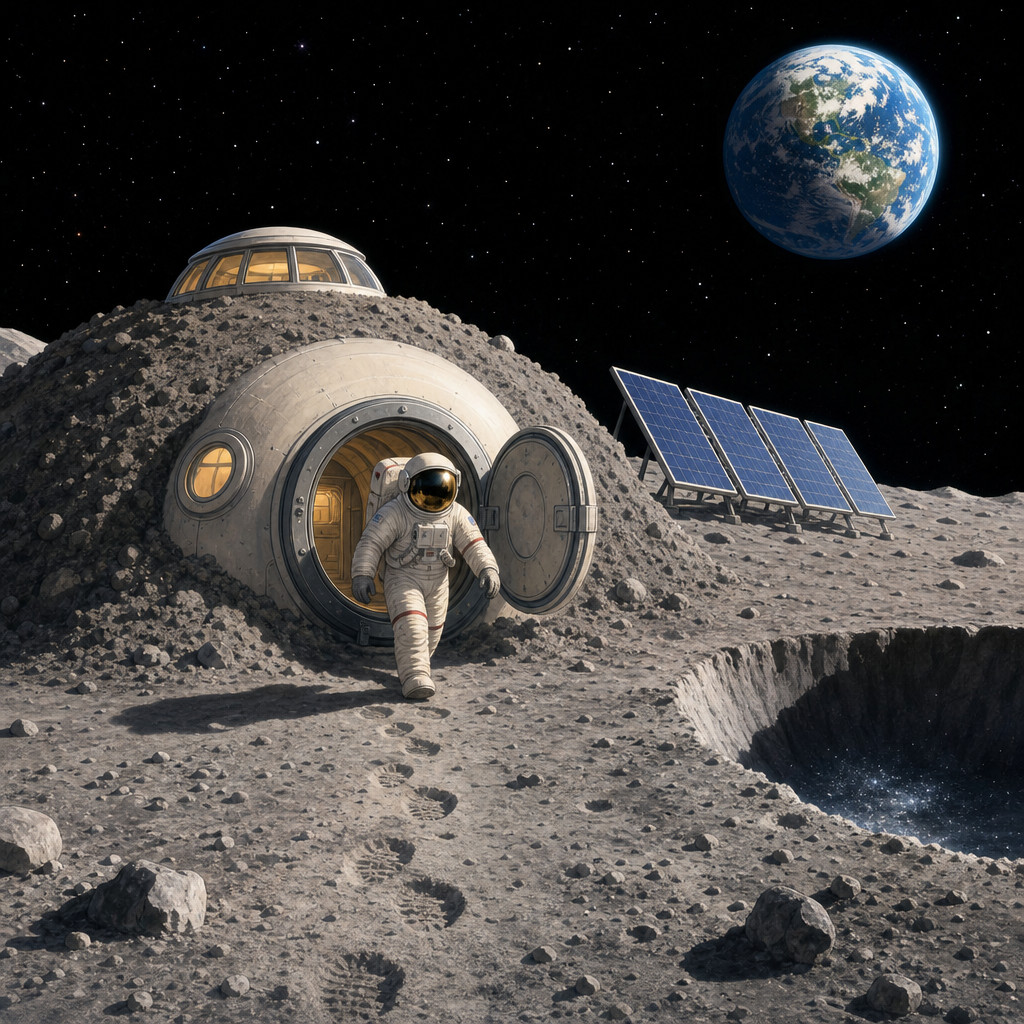
The Moon has shady places too, deep inside its craters, the big round bowls dented into its ground. Some of those craters look pitch black in pictures. So let's wonder together: can there be ice in the Moon's dark craters?
The answer begins at the Moon's poles, which means the top and the bottom ends of the Moon. Sunshine reaches the round Moon from the side, so at the poles it only skims low across the ground. The Moon hardly leans as it spins, so the Sun never climbs high there. It always hangs low near the ground, like our Sun in the late evening.
Low sunshine makes long shadows, just like your own shadow stretches out in the evening. Every crater has a rim, which means the high, rocky wall around its edge. At the poles, the rim blocks the low sunshine, so the light slides across the top and misses the crater floor.
So the floors of those craters stay in shadow all day and all night, year after year. The Moon keeps turning, yet the Sun never peeks over the rim. What do you think happens to a place that never feels a single ray of sunshine?
It gets cold, colder than any freezer and colder than the coldest night anywhere on Earth. Sunshine is what warms the Moon's ground, and these crater floors never get any. With nothing to warm them, they stay frozen all the time.
In a place that cold, ice cannot melt or slowly fade away. Remember the snow pile in the shade? At the Moon's poles the shade never ends, so ice can stay tucked into the cold gray dust of the crater floor for an extremely long time.
Scientists wanted to know if the ice is really there. They sent spacecraft to circle the Moon and look into those dark craters. They even crashed one rocket part into a shadowy crater to see what puffed up, and in that cloud of dust they found signs of water ice.
Poles and rim. Yes, there can be ice: at the Moon's poles the Sun stays so low that crater rims keep the floors in shadow forever, so they stay cold enough to keep ice frozen.
Next time you spot snow hiding in a shady corner, you can smile and think of the secret ice tucked away in the Moon's darkest craters.